The following excerpt was taken from 'Across The Park' by Peter Lupson, a new book that examines the shared heritage of Liverpool and Everton Football Clubs.
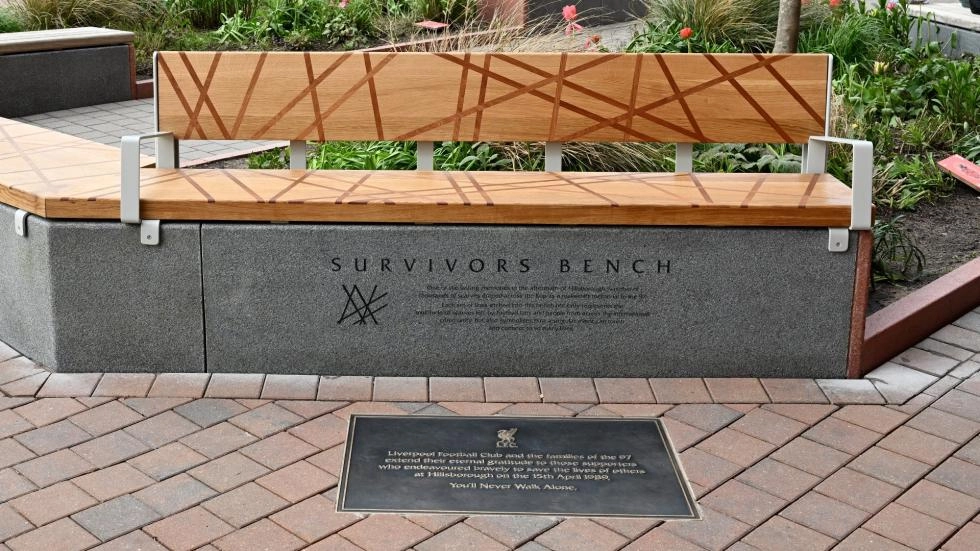
15 April 1989 is a date no Liverpool supporter will ever forget. It was the day on which one of the worst disasters in football history occurred, and its memory remains as vivid and horrifying as ever. The occasion was the FA Cup semi-final clash between Liverpool and Nottingham Forest at the Hillsborough stadium in Sheffield, a match that should have been an exciting cup tie with the added spice of the prospect of an all-Merseyside final at Wembley. But it turned out to be a nightmare of the worst kind.
The day started normally enough. Liverpool and Nottingham Forest had both enjoyed good seasons and there was an air of eager anticipation as both sets of supporters made their way to the ground in glorious sunshine. As the Liverpool supporters headed for the Leppings Lane end of the ground there was nothing at first to suggest a terrible tragedy was about to unfold. But about half an hour before kick-off, the congestion at the turnstiles had built to such an alarming level that supporters had become frightened and distressed. To relieve the pressure at the turnstiles, the police took the decision to open one of the exit gates in the perimeter wall. The consequences proved disastrous.
Within minutes of the gate being opened, some 2,000 Liverpool fans made their way onto the terrace, most going down a tunnel immediately in front of them. The tunnel led to two already full pens but they had no idea of this. As they pushed forward into the pens, the crush at the front by the perimeter fencing became intolerable for those unfortunate enough to be there. There was no means of escape. As the pressure from behind increased, many lost consciousness. Tragically, 96 never recovered.
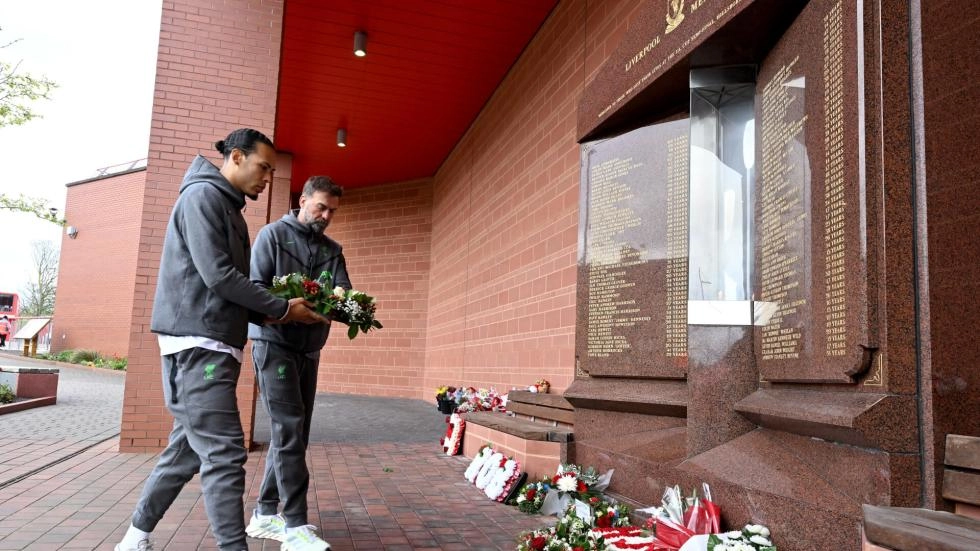
The shock and horror of the disaster reverberated throughout Britain and far beyond, but nowhere more so than on Merseyside, which was engulfed with grief. It was a grief of such intensity that it could not be carried alone. Its burden had to be shared. And instinctively Anfield became the place to share it.
Liverpool and Everton united in grief
That same night the Shankly Gates were adorned with flowers, but what had been a comparative trickle of people on the Saturday became a flood on Sunday as thousands made their way to Anfield. Partisan loyalties were immediately forgotten as Everton supporters rallied round their Liverpool counterparts to share their pain and sorrow. It was a city united in grief.
The ground was opened to the public and very quickly the goal in front of the Kop was bedecked with floral tributes and scarves. But they were not only in the red of Liverpool but also the blue of Everton. Along the crossbar was a red scarf tied to a blue one with a poppy attached to the knot. On the ground just in front of the goalmouth a little girl had placed a bunch of flowers and laid her blue and white scarf on it with the message: ‘To all the boys who died. From Rachel, an Everton fan.’ There were also wooden shields of both clubs tied side by side. On one the message read: ‘We should have been at Wembley together, but today we are together in grief.’ Liverpool manager Kenny Dalglish admitted the next day that he had wept at the sight of Liverpool and Everton supporters paying their tributes together. He said: “It was both the saddest and the most beautiful thing I have ever seen.”
Anfield remained open for the whole of the following week, from 9am until 7.30pm, and it is estimated that up to two million people came to pay their respects. But it was always noticeable that countless Everton supporters were among the mourners. At the Anfield Road end of the ground, where Evertonians stood to support their team on derby days, the goal was decked out in blue and white scarves in honour of the dead.
When Labour Party leader Neil Kinnock came to Anfield to pay his tributes, he was hugged by an emotional Liverpool fan who pleaded with him: “Tell the country the truth about Liverpool.” An Evertonian, standing close by, added: “Blue and red together Neil, tell them that.” As Kinnock looked across the pitch covered with flowers, he replied: “You only have to look here to see there’s almost as much blue as red. That’s what counts.” And he promised he would tell the House of Commons what he had seen at Anfield.
Everton's semi-final victory overshadowed
While the tragic events at Hillsborough were unfolding, Everton were engaged in a semi-final contest with Norwich City at Villa Park in Birmingham. The joy of their 1-0 victory over the Canaries that took them to Wembley was instantly dispelled as the terrible news from Hillsborough filtered through. Manager Colin Harvey and his players were deeply shocked and Pat Nevin, who scored the decisive goal, refused to discuss the match with reporters. His only thoughts were for the bereaved, and he was eloquent in his expressions of sympathy for them.
The Everton supporters in the coaches leaving Villa Park were also in sombre mood. One of them summed up his feelings in a letter to the Liverpool Echo three days later. It was headed “Just a gesture from an Evertonian” and is reproduced here in abbreviated form:
‘Three of us, all Evertonians, were out for a semi-final eve celebration. We were with another friend, a Liverpudlian. The sense of camaraderie and conviviality did the soul good... We were off to Villa, the Reds were off to Hillsborough... The coaches arrived. Reds here, Blues there.
[At the end of the game against Norwich] our whistle went. We had done it! Yes! Nevin got chaired off.
‘As we filed out, we heard it... The news spread like wildfire... We all knew somebody there. All of us... The radio on the coach told us. Pat Nevin told us. A very sombre coach indeed. Then 15 miles from home, we saw the first Liverpool coach. I’ve never felt so guilty about wearing a blue scarf all my life.’
It was signed: ‘With deepest sympathy, from Someone Blue.’
For Everton supporters, Wembley was the furthest thing from their minds. They only had thoughts for friends and loved ones who may have been at Hillsborough. Many waited anxiously with Reds’ fans at Lime Street Station as the first trains arrived home from Sheffield that night.
Everton immediately postponed their Central League home games against Derby County reserves and Derby’s first team that were due to be played that week. They would also have called off their match against Tottenham Hotspur the following Saturday, but it was away and had to be played. Supporters who did travel to Tottenham were subdued, still numb from the shock of Hillsborough. There was no chanting and no cheering. The only expressions of emotion were warm applause, first when the Tannoy announced music would not be played for birthday requests, then when floral tributes were laid, and finally after the minute’s silence to remember those who had died.
In the aftermath of the tragedy Kenny Dalglish and his Liverpool players did all they could to help the injured and bereaved, talking to fans, visiting hospitals and attending funerals. It was a massive emotional strain for them, and Blues boss Colin Harvey was quick to offer his support:
‘It goes without saying that my players will do anything they can to help. Whether it’s simply a matter of talking to the fans or attending funerals, we will be only too willing to play our part.’
Red and Blue at Liverpool's Cathedrals
Although Anfield became the main focus for the supporters’ grief, Liverpool’s two cathedrals also played a very important part in providing comfort. On the Sunday evening after the disaster, thousands flocked to the Roman Catholic Metropolitan Cathedral to attend a Requiem Mass. As the cathedral could only accommodate 3,000, another service had to be held for the 5,000 outside.
The service was led by the Archbishop of Liverpool, the Most Rev Derek Worlock, but he was joined by the Anglican Bishop of Liverpool, the Right Rev David Sheppard and the Free Church Moderator, Rev Dr John Newton. David Sheppard, although a former England cricketer, was a keen football fan and regularly watched Everton and Liverpool play. He had been away on holiday with his family in the Outer Hebrides but had been hurriedly transported back to Liverpool by helicopter in time for the Mass.
It was an emotional service and it struck a chord when Archbishop Worlock told the congregation: “The tragedy of Hillsborough has brought Liverpool to its knees – not in defeat but in prayer.” Looking around the congregation, he noticed the Liverpool and Everton players, Liverpool and Everton supporters wearing their scarves, and youngsters in replica Liverpool and Everton kits. With a smile he told them: “Thank you for being the marvellous people you are.”
After the service, Everton manager Colin Harvey spoke of the deep bond between the clubs:
“We are not a divided city. There are Evertonians and Liverpudlians in the same family. It was always going to be an occasion when we would come together and help each other. We reached Wembley on Saturday, but our feelings went from absolute elation to the very opposite when we heard what had happened.”
A fortnight later, on Saturday 29 April at 11am, a special memorial service was held in Liverpool’s Anglican Cathedral. It was led by Bishop Sheppard with the assistance of Archbishop Worlock and Dr John Newton. The Anglican Archbishop of York, the Most Rev John Habgood, and the Roman Catholic Archbishop of Westminster, Cardinal Basil Hume, also took part. In the congregation were Prime Minister Margaret Thatcher and the leader of the opposition, Neil Kinnock.
The 2,000 seats inside the cathedral were mostly allocated to the bereaved families, but giant television screens relayed the one-hour service to more than 8,000 people who had gathered outside the cathedral. Millions more watched on TV.
Among the first to arrive were the Liverpool and Everton teams, led by their managers Kenny Dalglish and Colin Harvey. Once again, the numerous Liverpool and Everton scarves in the cathedral showed the deep bond between the two clubs. This was never more evident than the poignant moment when the Books of Condolence with thousands of expressions of sympathy were carried to the altar by Everton supporter Andy McGrory and Liverpool supporter David Lynan. Dr Newton was moved to give thanks for the city’s “profound sense of unity in grief”.
The Mile of Scarves
The bonds between Everton and Liverpool were much in evidence in the immediate aftermath of Hillsborough but there was no symbol more powerful of their unity than ‘The Mile of Scarves’.
It was the brainchild of two Liverpool cab drivers, Jimmy Plunkett (28) and Tony Atkinson (26) who wanted to pay tribute to those who had died by forming a one-mile chain of Everton and Liverpool scarves linking Goodison Park and Anfield. As Jimmy explained: “I thought up the idea because it was a way of linking the two grounds and the supporters.”
Their initial estimate was that 2,500 would be needed for ‘The Chain of Unity’, but it turned out to be 4,000. An appeal went out to fans to donate their scarves and a special ‘scarfmobile’ toured Merseyside to collect them.
The response was enthusiastic and the required number was soon collected. The first scarf was tied to the gates of Goodison Park by Everton star Ian Snodin and from there the chain continued out of Bullens Road, over Walton Road, across Stanley Park and through the Bill Shankly Memorial Gates at Anfield to the Kop. On Saturday 22 April a moving ceremony led by Archbishop Worlock and Bishop Sheppard was held at Anfield for the tying of the final scarf to the Kop. It was attended by thousands, including the players of Everton, Liverpool and Tranmere Rovers.
The lengthy line was greeted with a deafening cheer on its arrival at Anfield where it was carried along the perimeter track to the Kop. At exactly 3.06pm, the time the game had been stopped the previous week at Hillsborough, a minute’s silence was observed to remember those who had died. At 3.07pm, while Bishop Sheppard read the ‘Lord’s Prayer’, Liverpool’s Peter Beardsley and Everton’s Ian Snodin joined hands with Barry Devonside, whose 18-year-old son Chris had died at Hillsborough, to tie the final scarf to the Kop. As one Liverpool fan wrote later: ‘It was a show of unity that incited such intense pride in the midst of such distress.’
It was not only in Liverpool that there was such a clear show of unity. At the London Marathon the next day, crowds lining the 26-mile course were moved to tears and broke into spontaneous applause as 250 Merseysiders wearing Liverpool and Everton strips ran the distance together singing ‘You’ll Never Walk Alone’. Outpourings of love such as this helped make the pain of Hillsborough just a little easier to bear.
Excerpt taken from 'Across The Park' by Peter Lupson.
Tagged: hillsborough , mile , park , scarves